INTRODUCTION
I'm not here to dry your face into mummy-mode or relive teenage cystic trauma. We’re talking pharmacological control of collagen synthesis using one of the most misunderstood drugs in dermatology: Isotretinoin.
At full dose, it could be brutal — skin dryness, liver stress, mood instability. But at microdoses, isotretinoin becomes a bio-signaling tool capable of increasing dermal collagen, tightening skin, improving texture, and reversing signs of aging through gene-level modulation.
This isn’t skincare. This is retinoid-level cellular reprogramming.
HOW IT WORKS (MoA)
Isotretinoin doesn’t just reduce oil. That’s surface-tier knowledge.
Its real action is genomic. Once ingested, isotretinoin is converted into all-trans retinoic acid (tretinoin) and 9-cis-retinoic acid, both of which bind nuclear receptors (RARs and RXRs) and initiate downstream transcriptional changes:
This is collagen stimulation at the source code level, not topical placebo fluff.
WHY MICRODOSE?
SCIENTIFIC EVIDENCE
Study 1 — Low-Dose Isotretinoin Increases Collagen Production in Aged Skin
Study 2 — Histologic and Molecular Effects of Oral Retinoids on Dermis
Study 3 — Effects of Retinoids on Photoaged Skin
DOSING STRATEGY (FOR COLLAGEN, NOT ACNE)
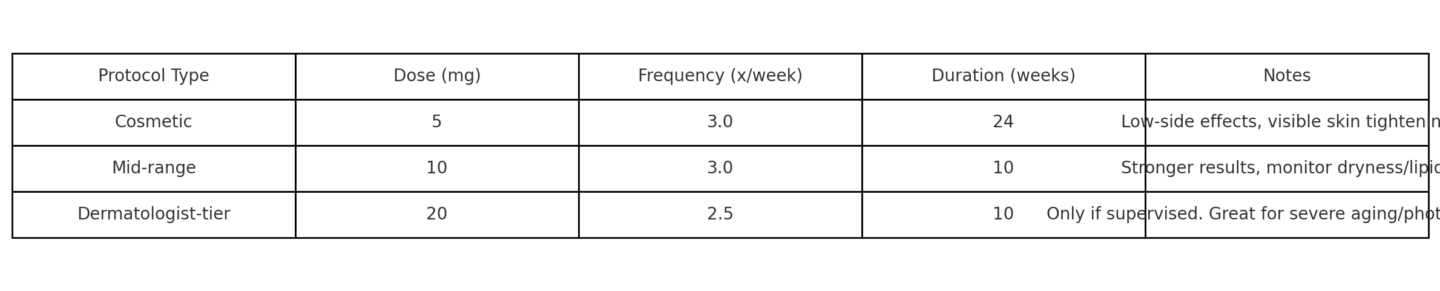
I know the formatting is bad but you get the point
SIDE EFFECTS & MITIGATION
WHY THIS WORKS FOR LOOKSMAXING
Forget “moisturizer glow.” This is actual structural reformatting. Collagen is what makes a 20-year-old look sharp and a 35-year-old look tired. Boosting collagen I and III levels means: